
How to Source Straw Tableware in 2026?

Sourcing straw tableware in 2026 requires more than comparing supplier prices. It demands traceable materials, verified food-contact safety, and realistic end-of-life claims. The term “Straw Tableware Tableware” may sound repetitive, but it reflects a growing search for plant-based dining products. Buyers should still define the material clearly. Straw fiber, wheat-straw residue, rice husk, and molded pulp behave differently in production.

The market is expanding, but evidence matters. The OECD’s Global Plastics Outlook reports that global plastic waste could nearly triple by 2060 without stronger policy action. This pressure is increasing demand for fiber-based alternatives. However, the Ellen MacArthur Foundation warns that “compostable” packaging needs suitable collection and treatment systems. A certified product may not compost in a household bin. That distinction is often missed.

Look closely.

A reliable sourcing process should examine factory audits, batch records, migration testing, moisture resistance, and packaging conditions. Request samples after hot soup, oily food, and refrigerated storage. Check whether rims soften after ten minutes. Ask for testing against applicable food-contact requirements in the destination market. EN 13432 and ASTM D6400 can support compostability claims, but they do not replace local regulatory review. Supplier declarations also need independent verification.

Industry reports from Smithers and Grand View Research indicate continued investment in sustainable packaging, yet market forecasts vary by material definition and region. Treat them as signals, not guarantees. A cheaper product may hide weak traceability, inconsistent sizing, or excessive transport damage. In practice, the best 2026 supplier balances performance, documentation, capacity, and honest environmental limits. That balance is still imperfect. But it is measurable.
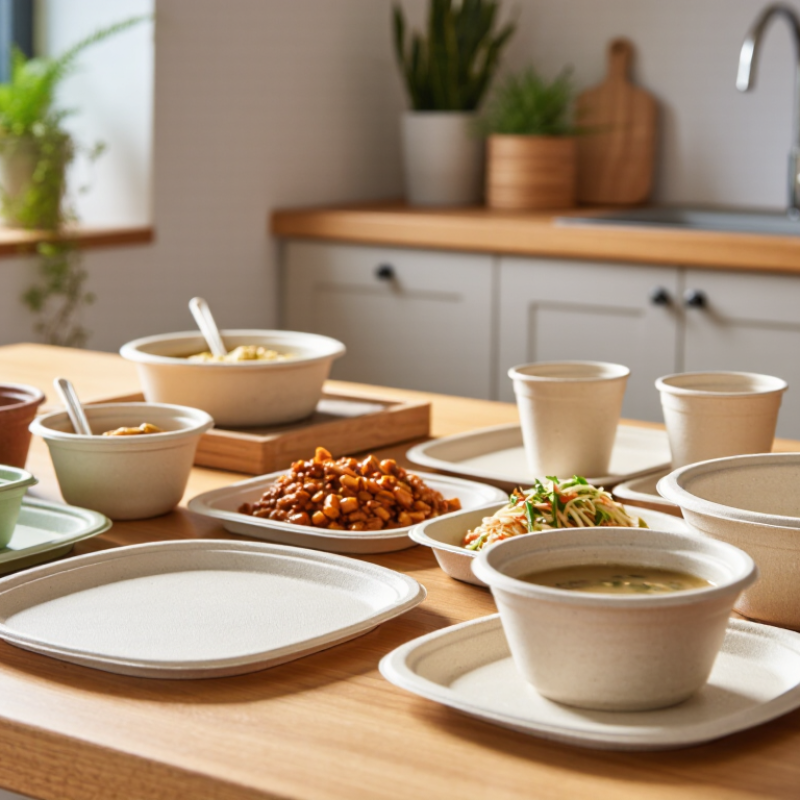
How to Source Straw Tableware in 2026?

Define Straw Tableware Requirements and Sustainability Goals

Sourcing straw tableware in 2026 should begin with a precise product definition. “Straw” may mean wheat stalk fiber, rice husk, bamboo fiber, or a blended material. Ask for the complete formulation, including binders, coatings, and colorants. Natural-looking products are not automatically compostable. Confirm food-contact compliance, temperature limits, oil resistance, microwave use, and expected shelf life. Request migration tests from an accredited laboratory, not only a supplier declaration.

Set measurable sustainability goals before comparing quotations. The OECD’s Global Plastics Outlook reported that only 9% of plastic waste was recycled in 2019. This supports reducing virgin plastic, but replacing it with fiber is not automatically better. Measure renewable content, recycled content, manufacturing energy, water use, packaging weight, and transport distance. A supplier should provide batch traceability and credible lifecycle information. The UNEP report Turning off the Tap states that plastic pollution could fall by 80% by 2040 through reuse, recycling, and material redesign. Reuse may deserve more attention than a single-use fiber item.

End-of-life claims need careful testing. Require evidence for industrial compostability under recognized standards, such as EN 13432 or ASTM D6400, when relevant. Check whether local facilities actually accept the product. They often do not. I would also test samples with hot soup, greasy food, and twenty minutes of holding time. One weakness remains: many “straw” products use undisclosed adhesives. That detail can change the disposal route and the entire sustainability calculation.

Identify Reliable Suppliers and Verify Material Standards

How to Source Straw Tableware in 2026?

Reliable sourcing starts with material evidence, not attractive product photos. Ask suppliers whether the product uses wheat straw fiber, bagasse, bamboo, or plastic blends. Request a full composition statement and batch-specific certificates of analysis. The OECD’s Global Plastics Outlook projects global plastic waste could reach 1.014 billion tonnes by 2060, compared with 353 million tonnes in 2019. This makes honest material disclosure increasingly important.

Check food-contact testing for the destination market. Relevant evidence may include overall migration, heavy metals, PFAS, and microbial safety tests. Compostability claims require careful review. EN 13432 supports industrial compostability, but it does not automatically prove home compostability. A supplier should provide test reports from an independent laboratory, not only an internal declaration. Ask for production photographs, factory addresses, traceability records, and retained samples. Small details matter. Moisture, odor, edge cracks, and warping often appear after storage.

UNEP’s 2023 Turning off the Tap report says plastic pollution could be reduced by 80% by 2040 through reuse, recycling, and material redesign. However, replacing plastic with plant fiber does not remove every sourcing risk. A natural-looking product may still contain undisclosed additives or coatings. I would compare at least three batches before placing a large order. That step feels slow. It is still cheaper than discovering inconsistent materials after delivery. Supplier audits should also examine drying controls, contamination prevention, worker safety, and wastewater handling. Documentation can be incomplete, and that weakness deserves further review.

Compare Product Quality, Customization, Pricing, and Minimum Orders

Sourcing straw tableware in 2026 requires more than checking a “natural” label. Wheat-straw products may contain plant fiber, polypropylene, or biodegradable polymers. Request the exact material ratio, food-contact test reports, and migration results. The World Bank’s What a Waste 2.0 estimates global municipal waste could reach 3.40 billion tonnes by 2050. Material claims deserve careful testing. Ask for samples from the actual production line, not showroom pieces. Check rim smoothness, odor, staining, heat resistance, and cracking after repeated use. One sample is not enough.

Customization affects both quality and pricing. Mold changes usually increase tooling costs, while logos may require printing, embossing, or color matching. Request a written quotation separating product, mold, packaging, testing, and shipping charges. Compare prices by usable piece, not carton price alone. Minimum orders often rise with custom colors and new molds. A practical first order may use an existing shape with custom packaging. It is less impressive, but easier to control. The UNEP report Turning off the Tap states that plastic pollution could be reduced by 80% by 2040 through reuse, redesign, and better recycling. Do not treat “compostable” as universal. Confirm whether the product meets EN 13432 or ASTM D6400, and whether local facilities accept it. Certification can be costly, and documentation may be incomplete. That is a sourcing risk. Record every supplier response in a comparison sheet, including lead time, batch tolerance, replacement policy, and test-report validity.

How to Source Straw Tableware in 2026? - Compare Product Quality, Customization, Pricing, and Minimum Orders

Product Type Typical Material Product Quality Indicators Customization Options Indicative Price
per Unit (USD)
Typical MOQ Typical Lead Time Best Use
Reusable Plate
20–23 cm diameter
Food-grade polypropylene blended with wheat-straw fiber Uniform wall thickness, smooth edges, low odor, stable color, dishwasher resistance generally tested around 70–100°C depending on formulation Color matching, embossed logo, printed packaging, shape and diameter changes $0.35–$1.20 1,000–3,000 pcs 25–45 days Households, cafés, schools and promotional programs
Reusable Bowl
400–700 ml capacity
Food-grade polypropylene with plant-fiber filler Rigid base, balanced rim, resistance to cracking, verified food-contact migration performance, consistent internal volume Capacity, rim profile, color, molded logo, sleeve and carton design $0.45–$1.45 1,000–3,000 pcs 25–50 days Cereal, soup, takeaway and institutional dining
Reusable Cutlery Set
Fork, spoon and knife
Polypropylene combined with wheat-straw fiber or other plant fiber Smooth handle, no sharp flash, adequate flex strength, secure fit, food-contact testing and repeated-wash evaluation Handle shape, color, logo, pouch, paper sleeve and gift-box packaging $0.25–$0.90 per set 2,000–5,000 sets 30–50 days Meal kits, events, employee dining and retail bundles
Reusable Cup
250–450 ml capacity
Food-grade polypropylene with plant-fiber content; optional silicone lid Leak-resistant lid fit, stable base, heat-use instructions, low odor and dimensional stability after washing Cup shape, lid color, measurement marks, logo, packaging and bundled accessories $0.60–$2.00 1,000–3,000 pcs 30–55 days Cold beverages, office use and reusable campaign merchandise
Disposable Molded Plate
18–23 cm diameter
Molded bagasse or wheat-straw agricultural-fiber pulp Even molding, dry and wet strength, oil resistance, compostability documentation and absence of visible fiber clumps Shape, compartment layout, embossing, pack count and printed outer packaging $0.08–$0.30 10,000–50,000 pcs 20–40 days Catering, festivals, food service and short-term events
Disposable Molded Bowl
350–750 ml capacity
Molded agricultural-fiber pulp, commonly bagasse or wheat-straw fiber Leak resistance, hot-food performance, stackability, oil resistance and independently documented compostability claims Capacity, rim design, compartment structure, embossing and pack configuration $0.10–$0.38 10,000–50,000 pcs 20–45 days Soups, noodles, salads and takeaway meals
Custom Premium Set
Plate, bowl, cup and cutlery
Reusable food-grade polymer with plant-fiber filler, silicone or paper packaging components Consistent color across items, tight dimensional tolerances, documented food-contact compliance and packaging drop-test results New tooling, complete color system, multi-color molding, logo, inserts, retail packaging and barcode labeling $2.50–$8.00 per set 3,000–10,000 sets 45–75 days, excluding tooling Retail launches, hospitality programs and corporate gifting
Purchasing notes: Prices are indicative 2026 export-market ranges in USD per unit for medium-volume orders and exclude freight, duties, tooling, testing and taxes. Reusable products should be checked for food-contact compliance, migration limits, odor, heat-use instructions and dishwasher performance. Compostability claims for molded fiber products should be supported by certification applicable to the destination market. Final pricing and MOQ depend on product dimensions, material formulation, packaging, decoration, order volume and delivery terms.

Assess Certifications, Compliance, Packaging, and Supply Chain Risks

How to Source Straw Tableware in 2026?

Sourcing straw tableware requires more than checking color, shape, and price. Confirm the material composition before requesting samples. “Straw” may describe wheat fiber, rice husk, bamboo fiber, or a blended plastic product. Ask for the exact formula, additives, and manufacturing location. Food-contact compliance must match the destination market. Request current migration, heavy-metal, odor, and temperature-resistance test reports from an independent laboratory. Certificates alone are not enough. Check their scope, issue date, product code, and testing method.

Packaging can create hidden risks. A supplier may use recycled cartons, but moisture can damage uncoated tableware during sea transport. Inspect inner bags, carton strength, pallet wrapping, and stacking limits. Ask for drop-test or compression-test evidence. Packaging should also show lot numbers and production dates. This supports traceability when a customer reports an odor or cracked edge. I have seen attractive samples fail after humid storage. That weakness is easy to miss.

Tips: Approve a sealed sample before mass production. Test it after hot filling, repeated washing, and short-term storage. Keep a retained sample from every batch. Consider two qualified suppliers, but do not assume they use identical materials. Compare their test reports carefully. Build extra time into the purchase plan for laboratory retesting, port delays, crop variations, and packaging changes. Some checks feel excessive. They are usually cheaper than recalling a full shipment.

Finalize Samples, Contracts, Quality Control, and Delivery Plans

How to Source Straw Tableware in 2026?

In 2026, sourcing straw tableware should begin with a controlled sample process. Ask suppliers for samples from the intended production line, not showroom pieces. Check surface smoothness, odor, color consistency, edge finishing, and dimensional accuracy. Fill each item with hot soup, cold drinks, and oily foods. Record changes after washing and repeated handling. Small details matter. A lid that loosens after ten uses can damage customer trust. I have seen teams approve attractive samples before testing actual packaging conditions.

The contract should define material composition, permitted additives, product drawings, tolerances, and approved sample references. Include inspection methods and acceptable defect limits. Specify who pays for retesting when results fail. Ask for batch records and traceability documents. Independent food-contact testing can verify safety claims and migration limits. Do not rely on a supplier’s verbal assurance. Paperwork is evidence. Still, perfect clauses cannot repair vague drawings.

Before production, create a pre-shipment checklist with photos and measurable criteria. Inspect quantity, carton strength, labeling, moisture protection, and loading conditions. Use an agreed sampling plan, then keep sealed reference units. For delivery, confirm production dates, booking windows, transit risks, and receiving capacity. Build buffer around seasonal demand. A two-week buffer helps. Yet my own planning has missed port delays. Recheck lead times with current carrier data, and keep a practical backup route. At arrival, inspect cartons before signing an unqualified receipt. Photograph damage immediately.

How to Source Straw Tableware in 2026?

Typical sourcing timeline for final samples, contracts, quality control, and delivery planning.

A practical sourcing plan usually takes about 14 weeks from supplier screening to delivery readiness. Sample finalization and production require the most coordination, while inspection and documentation should be completed before shipment booking.

Shopping cart