Where to Buy China Best Plastic Coupe Glasses?

Where to Buy China Best Plastic Coupe Glasses? This question deserves more than a low-price comparison. Buyers must assess material safety, design consistency, supplier reliability, and delivery performance. Plastic Coupe Glasses should look elegant under event lighting, while remaining stable on trays and resistant to ordinary service impacts.

Industry data supports this growing category. Grand View Research reports continued expansion in the global plastic tableware market, driven by hospitality, catering, and convenience-focused consumption. Smithers also identifies food-contact packaging as a quality-sensitive sector, where traceability and compliance increasingly influence purchasing decisions. These reports do not prove that every Chinese supplier offers superior products. They show why structured evaluation matters.

A reliable sourcing process begins with product samples. Check the rim for sharp edges, the stem for twisting, and the bowl for cloudy molding marks. Ask for material specifications, production photos, batch records, and food-contact test documentation. Depending on the destination market, relevant evidence may include FDA requirements, EU Regulation (EC) No. 1935/2004, or LFGB testing. ISO 9001 certification can support process confidence, but it cannot replace independent inspection.

Look beyond polished catalog images. A supplier with clear communication, stable lead times, and transparent packaging details is often safer than the cheapest option. I have seen attractive samples hide weak cartons and uneven bases. That mistake is easy to make. It is also avoidable.

The best purchasing channel may be a verified manufacturer, an audited export company, or a reputable B2B platform. Compare minimum order quantities, customization costs, replacement policies, and shipping terms before deciding. Quality is not a single feature. It is the result of repeatable evidence.

Where to Buy China Best Plastic Coupe Glasses?

What Are Plastic Coupe Glasses and Why Choose Chinese Manufacturers?

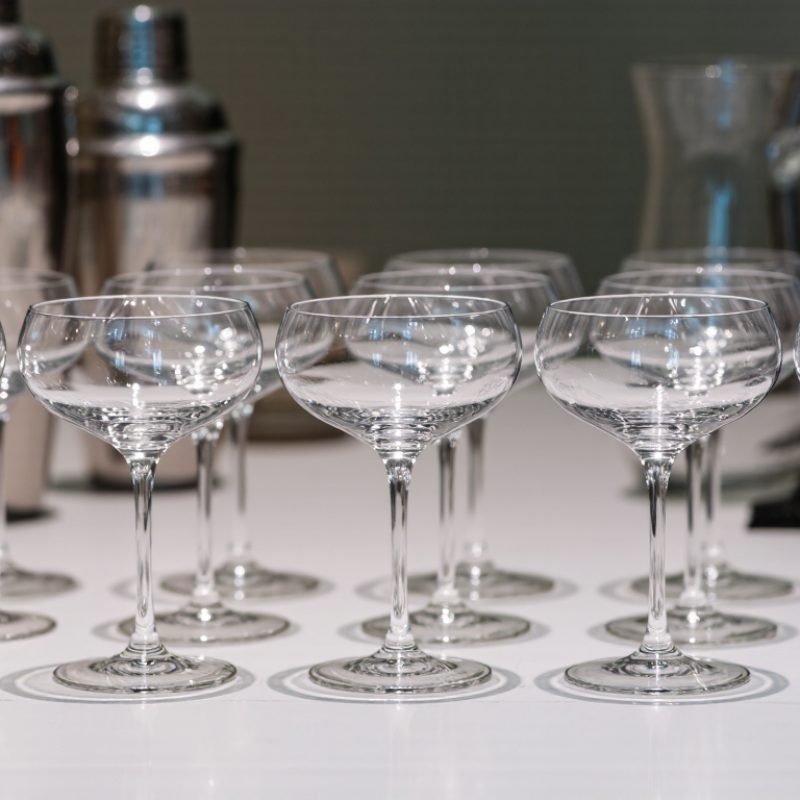
Plastic coupe glasses are lightweight alternatives to traditional glassware. They have a wide, shallow bowl, a stem, and a vintage cocktail silhouette. Common materials include acrylic, SAN, polypropylene, and Tritan copolyester. Each material behaves differently.

Acrylic offers clear appearance and good visual appeal, but it can scratch more easily. SAN often provides better rigidity and shine. Tritan copolyester is popular for reusable drinkware because it combines clarity with impact resistance. The right choice depends on washing methods, event conditions, and expected service life. Not every “unbreakable” claim deserves trust.

Chinese manufacturers are attractive because they often provide flexible production options. Buyers can request custom colors, stem shapes, surface textures, packaging, and mold designs. Many factories also support sample development before mass production. This makes small design changes easier to test. However, low pricing should never replace inspection. A practical buyer should examine wall thickness, stem strength, rim smoothness, and balance on a flat table.

Ask for material specifications and food-contact test reports that match the destination market. Confirm whether the glasses are dishwasher-safe, reusable, or intended for limited service. During sampling, fill each glass and gently move it across a table. Weak joints usually reveal themselves quickly. I would also compare several suppliers, not just the fastest quotation. Factory photos can look convincing, yet production consistency may still vary. A clear specification sheet, documented quality checks, and pre-shipment inspection create more dependable purchasing decisions.

How to Identify China’s Best Plastic Coupe Glass Suppliers

Finding China’s best plastic coupe glass suppliers requires more than comparing online photos. I inspect product samples, factory records, and communication quality. A reliable supplier should explain the plastic type, wall thickness, capacity, and temperature limits clearly. Vague answers deserve caution.

Ask for a physical sample before placing a large order. Check the rim for sharp edges, the stem for wobbling, and the bowl for cloudy marks. Fill the glass with water and leave it overnight. This simple test can reveal leaks or weak joints. Request food-contact test documents and production photos, but verify whether the documents match the actual material. Paperwork alone is not proof.

Factory experience matters. Suppliers serving hotels, event companies, or catering wholesalers usually understand packing pressure and repeated handling. Ask how many glasses fit in one carton and whether dividers prevent scratches. I once accepted attractive samples with poor carton protection, and several pieces arrived damaged. That mistake changed my inspection checklist. Also discuss mold ownership, sample revisions, minimum order quantities, and production schedules in writing. Fast replies help, but precise replies matter more. Some suppliers may promise too much. Leave room for delays.

Where to Find Reliable Chinese Coupe Glass Manufacturers and Wholesalers

Reliable sourcing starts with the factory, not the catalog. China’s National Bureau of Statistics reported approximately 74.9 million tonnes of plastic-product output in 2023. This scale supports broad manufacturing capacity, but capacity does not guarantee consistent coupe glasses. Request factory registration details, material specifications, food-contact test reports, and recent production photos. Ask whether the glasses use acrylic, polycarbonate, or PET. Each material differs in clarity, impact resistance, and temperature performance.

Samples reveal details that websites hide. Check the rim for sharp edges, the stem joint for wobbling, and the bowl for cloudy patches. Measure the actual capacity with water. A reliable manufacturer should explain mold costs, minimum order quantity, color matching, carton design, and replacement procedures. For wholesalers, confirm inventory location and batch traceability. One practical warning: “in stock” may mean unfinished units awaiting inspection. Get that point in writing.

The United Nations Environment Programme reported that global plastic production rose from 234 million tonnes in 2000 to 460 million tonnes in 2019. Buyers should therefore examine material declarations and packaging reduction plans. Reusable plastic coupe glasses can support repeated service, but only when their washing limits are documented. I once underestimated carton compression during sampling; several rims arrived scratched. That mistake changed my checklist. Request drop-test evidence, inner dividers, and photographs of sealed cartons before payment. A dependable Chinese supplier answers specific questions without rushing the decision. That matters more than polished product images.

Where to Buy China’s Best Plastic Coupe Glasses?

Common Coupe Glass Capacity Options for Manufacturer and Wholesale Sourcing

These capacity ranges represent commonly offered coupe glass formats in wholesale catalogs. Smaller 150–180 ml glasses are suitable for tasting portions and events, while 240–270 ml options are more suitable for standard cocktail and hospitality service. Buyers should confirm material type, food-contact compliance, mold quality, packaging, and minimum order quantity with each Chinese manufacturer or wholesaler.

What Quality, Safety, and Customization Standards Should You Check?

Where to Buy China Best Plastic Coupe Glasses?

When sourcing plastic coupe glasses from China, inspect material before appearance. Ask for food-contact documentation, resin identification, and migration-test results. The EU Regulation 10/2011 sets an overall migration limit of 10 mg per square decimeter for plastic food-contact materials. Confirm the supplier tested the finished glass, not only the raw resin.

Material choice affects safety and service life. Tritan-style copolyester, polycarbonate, SAN, and acrylic behave differently under heat, impact, and washing. Request test data for cracking, clouding, odor, and dishwasher cycles. The U.S. FDA evaluates food-contact substances by potential migration and exposure, so vague “food grade” claims are not enough. They sound reassuring. They prove little.

Customization needs equal discipline. Check wall thickness, rim smoothness, stem strength, color consistency, logo durability, and carton drop testing. The OECD reported 353 million tonnes of plastic waste globally in 2019, with packaging representing about 40 percent of plastic use. That figure makes unnecessary over-packaging difficult to defend. Ask for recyclable packaging and accurate product-weight data. A 2023 industry report from PlasticsEurope recorded 57.2 million tonnes of plastics converted in Europe, showing how material selection influences large-scale resource use. I would still request independent laboratory verification; supplier paperwork can contain errors. A sample may look perfect, yet fail after repeated washing. Check twice.

Where to Buy China Best Plastic Coupe Glasses? - What Quality, Safety, and Customization Standards Should You Check?

Evaluation Dimension Recommended Material or Standard What to Check Before Purchasing Required Evidence or Test Information Practical Acceptance Benchmark
Glass Material Food-contact polypropylene (PP), Tritan-type copolyester, or other declared food-contact plastic Confirm the exact resin type, whether the material is virgin or recycled, and whether additives, colorants, and processing aids are suitable for food contact. Material declaration, technical data sheet, food-contact compliance statement, and batch traceability information. Material composition is clearly disclosed and consistent with the supplied product.
Food-Contact Compliance Applicable requirements in the destination market Check compliance with the relevant food-contact framework, such as United States FDA requirements or European Union Regulation (EU) No. 10/2011 for plastic food-contact materials. Recent laboratory test report identifying the tested material, product type, test conditions, and report number. The report covers the actual cup, decoration, coating, and color used in production.
Chemical Migration Specific and overall migration limits appropriate to the intended use Verify testing with food simulants and exposure conditions that match beverages, contact time, temperature, and repeated-use conditions. Overall migration and relevant specific migration test results from a competent laboratory. All tested substances comply with the destination market’s applicable limits.
Restricted Substances Controls for BPA, heavy metals, phthalates, lead, cadmium, and other restricted substances Ask whether the cup, pigments, printed ink, and surface coating have been assessed separately where applicable. Restricted-substance screening report and declaration of conformity for the finished decorated item. No restricted substance exceeds the applicable legal or customer limit.
Odor and Taste Neutral sensory characteristics after washing and normal beverage contact Inspect samples for plastic odor, flavor transfer, surface residue, and odor retention after exposure to water, juice, soft drinks, or alcoholic beverages. Sensory inspection record and sample evaluation under defined conditions. No noticeable odor or off-taste is detected during intended use.
Impact Resistance Design and resin selected for repeated handling and service use Check the stem-to-bowl joint, rim, foot, and molded corners for cracking, whitening, sharp fragments, or loosening after drops and repeated handling. Internal drop-test procedure, sample quantity, drop height, surface type, and pass/fail results. No sharp breakage, leakage, or structural separation in the agreed test sample.
Dimensional Accuracy Controlled capacity, rim diameter, height, foot diameter, and wall thickness Compare production samples with the approved drawing. Confirm that the bowl is balanced and the stem is centered. Technical drawing, tolerance sheet, inspection report, and calibrated measurement records. Dimensions remain within the approved tolerance range and the glass stands level.
Capacity Accuracy Nominal capacity stated in milliliters or fluid ounces Define whether capacity means brim-full volume or fill-to-line volume. Check usable capacity for the intended serving style. Capacity measurement method and inspection results from production samples. Actual capacity matches the approved specification within the agreed tolerance.
Thermal Performance Temperature range must match the intended beverage service Confirm whether the product is intended for cold drinks only or also for warm beverages. Do not assume that a plastic cup is microwave-safe or heat-resistant. Temperature-use declaration and thermal cycling or heat-deflection test data when relevant. Use only within the supplier’s documented temperature range.
Dishwasher Suitability Only claim dishwasher suitability when tested for the intended cleaning cycle Check warping, cloudiness, cracking, decoration loss, and loss of transparency after repeated dishwasher cycles. Defined dishwasher-cycle procedure, detergent conditions, cycle count, and before-and-after inspection records. No unacceptable deformation, cracking, or decoration deterioration after the agreed cycle count.
Surface Finish Smooth, cleanable, non-abrasive food-contact surfaces Inspect the rim, inner bowl, stem joint, and foot for burrs, sharp edges, sink marks, flash, scratches, and trapped residue. Visual inspection standard with approved limit samples or defect photos. No sharp edges, exposed contamination, or defects that affect cleaning or safe handling.
Stability and Safety Balanced coupe profile with stable foot geometry Test the glass on a flat surface and check resistance to tipping when empty and filled to the intended serving level. Stability inspection method, level-surface requirement, and test records. The glass remains upright during normal placement and service handling.
Color and Transparency Colorants suitable for the declared food-contact application Check color uniformity, transparency, pigment dispersion, and whether the color changes after washing, sunlight exposure, or beverage contact. Approved color standard, color measurement records where required, and pigment compliance documentation. Color matches the approved sample without visible streaks, patches, or unacceptable fading.
Printing and Decoration Food-safe decoration system appropriate for the decorated surface Confirm whether printing is on the exterior only and evaluate adhesion, abrasion resistance, dishwasher resistance, and migration risk. Ink or coating compliance statement, rub-test results, and finished-product migration assessment where applicable. Decoration remains legible, firmly attached, and outside direct beverage contact unless specifically qualified.
Customization Custom mold, color, capacity, logo, packaging, and surface finish Confirm mold ownership, minimum order quantity, tooling cost, sample approval process, artwork format, and change-control procedure. Approved drawing, signed golden sample, artwork proof, mold specification, and pre-production sample record. Mass production follows the approved sample and documented specifications.
Packaging Protection Individual protection suitable for stacking and international transport Check separators, inner cartons, master-carton strength, moisture protection, pallet configuration, and protection against stem breakage. Packaging specification, carton-drop test or transport simulation results, and packing photographs. Products arrive without cracks, scratches, deformation, or decoration damage.
Quality Control Documented incoming, in-process, and final inspection controls Review inspection frequency, defect classification, sampling plan, calibration system, and corrective-action process. Quality-control plan, inspection checklist, nonconformity records, and final inspection report. Critical safety defects have zero acceptance, with agreed limits for major and minor defects.
Traceability Traceable production date, material batch, mold, and shipment lot Confirm that finished cartons and production records can be linked to resin batches, colorants, decoration materials, and inspection results. Lot-code format, batch records, packing list, and retained-sample procedure. A quality issue can be traced back to the relevant production batch.
Sustainability Information Accurate recyclability and recycled-content claims Do not rely on general “eco-friendly” wording. Check the actual resin identification, recycled content percentage, additives, and local recycling compatibility. Material declaration, recycled-content verification where claimed, and disposal or recycling guidance. Environmental claims are specific, documented, and appropriate for the destination market.
Pre-Shipment Approval Production sample approval before full shipment Inspect appearance, dimensions, capacity, stability, decoration, packaging, and safety documentation against the approved specifications. Pre-shipment inspection report, retained reference sample, and signed approval record. Shipment is released only after all critical requirements are verified.

Selection principle: Choose the product whose material, testing, customization, and quality records match the destination market and the actual conditions of use. Compliance documents should identify the finished product and its decoration, not only an unspecified raw plastic material.

How to Compare Prices, Samples, Minimum Orders, and Shipping Terms

Where to Buy China Best Plastic Coupe Glasses?

How to Compare Prices, Samples, Minimum Orders, and Shipping Terms

Buying plastic coupe glasses from China requires more than comparing the lowest quotation. Ask for a complete price breakdown. Check the unit price, mold cost, packaging, printing, and inland delivery. A cheap offer may exclude export cartons or protective inserts.

I once compared two quotations and missed a packaging charge. The final difference was surprisingly large.

Request physical samples before placing a production order. Examine the rim, stem connection, transparency, weight, and base stability. Fill each glass with water and test it on a smooth table. Ask whether the sample uses the same material and production method as the final batch. Sample fees may be refundable, but confirm the condition clearly. Small details matter.

Check the minimum order quantity against your sales forecast. A lower MOQ often carries a higher unit price. Ask for price tiers, such as 500, 1,000, and 5,000 pieces.

Compare the delivered cost, not only the factory price. Shipping terms should state the transport method, delivery point, insurance, and estimated timeline.

Request carton dimensions and gross weight for freight calculations. Delays can happen.

Ask for material specifications and food-contact documentation when relevant to your market. Confirm color consistency and replacement policies in writing.

I would also request production photos before shipment, although photos cannot replace inspection. Some buyers rely too heavily on promises. That is a mistake worth reconsidering.

Shopping cart